
The smallest aircraft on our partner operators' aircraft page and the one with the clearest job: four or five people, European sectors of up to about two and a half hours, and a cabin that is long for its class at 5.43 m. Range is 2,037 km, which is the shortest we publish, so this page is mostly about drawing the line honestly rather than claiming it goes everywhere.
REQUEST A QUOTEEvery figure in this block is copied from the specification table on our partner operators' aircraft page for this type. Nothing here is a manufacturer brochure number and nothing has been rounded up.
2,037 km of published range. That is the shortest figure on our partner operators' aircraft page, and it means that of the forty-eight routes published on this website, thirty-five are inside it and thirteen are not. Naming the thirteen is more useful than not naming them.
The thirteen the HondaJet does not reach nonstop on the published figure are all the sectors of 2,461 km and longer: the seven Gulf routes, the two Cyprus runs from London, London to Mykonos, Larnaca to Nice and the two longest western Mediterranean sectors. That is the honest answer, and it is why we would put a midsize type forward for any of them.
What is left is the great majority of the network, and it is where this aircraft is genuinely well matched. The longest route it takes with margin is London to Malaga at 1,721 km, 316 km inside the figure. Nice to Athens at 1,542 km, Rome to London at 1,488 km and London to Ibiza at 1,452 km all sit comfortably inside.
From there down the aeroplane is simply doing what it was built for. London to Nice at 1,074 km, Geneva to London at 753 km, London to Paris at 380 km, Geneva to Nice at 300 km: these are half-hour to two-hour sectors for four people who want the aircraft to be waiting when they arrive, not a cabin to sleep in.
A short-range aircraft is also, on the right sector, the cheapest way to charter. The trade is that there is no margin for the long way round: when an airspace closure or a weather diversion adds two hundred kilometres to a routing that was already near the limit, a light jet feels it and a midsize one does not. On sectors under 1,500 km that trade is almost always worth making.
Published range is a specification, not a clearance. The operating crew plan each flight against actual weight, weather and alternates. Where a sector on this website is beyond the published figure we have said so rather than left it to the table.
| Published route | Distance | Nonstop? | Margin against the published range |
|---|---|---|---|
| London to Dubai | 5,500 km | No | Beyond the published range by 3,463 km |
| Amsterdam to Dubai | 5,169 km | No | Beyond the published range by 3,132 km |
| Geneva to Dubai | 4,920 km | No | Beyond the published range by 2,883 km |
| Zurich to Dubai | 4,769 km | No | Beyond the published range by 2,732 km |
| Milan to Dubai | 4,662 km | No | Beyond the published range by 2,625 km |
| Dubai to Munich | 4,565 km | No | Beyond the published range by 2,528 km |
| Vienna to Dubai | 4,224 km | No | Beyond the published range by 2,187 km |
| London to Larnaca | 3,288 km | No | Beyond the published range by 1,251 km |
| Athens to Dubai | 3,273 km | No | Beyond the published range by 1,236 km |
| London to Paphos | 3,228 km | No | Beyond the published range by 1,191 km |
| London to Mykonos | 2,568 km | No | Beyond the published range by 531 km |
| Larnaca to Nice | 2,461 km | No | Beyond the published range by 424 km |
Below 2,400 km every remaining route on this website is inside the published range, though on the longest of them the margin is 316 km rather than a comfortable thousand. These are the mid-length sectors, from about an hour and a quarter to two and a half hours by our own published flight-time estimates.
Distances are great-circle figures between airport coordinates from the OurAirports open dataset, retrieved 23 August 2026. Flight times quoted anywhere on this page are estimates from a model fitted to the flight times Diamond Executive Aero Services already publishes, not measured block times. The 19 routes shorter than 700 km are listed on the route index. Range figures are the ones published on our partner operators' aircraft page and assume still air, optimum cruise and a sensible payload.
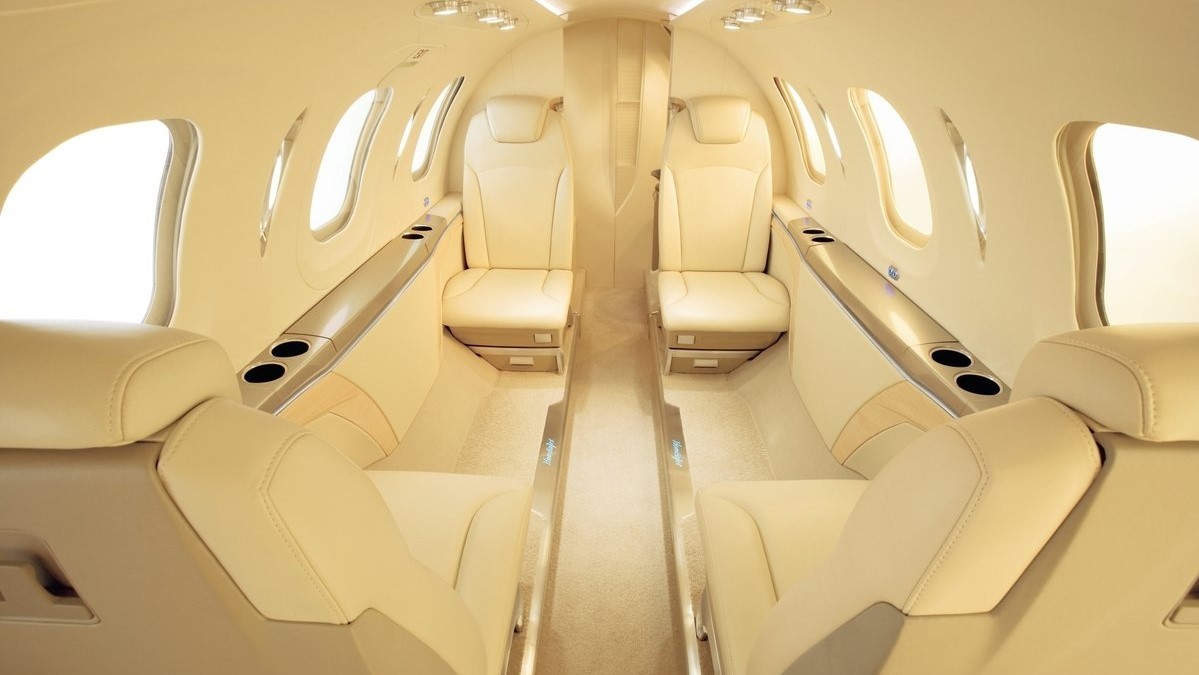
5.43 m long, 1.52 m wide, 1.47 m high, four or five seats and 1.60 m³ of hold. In the light class those are good numbers, and the height is the one to be clear about.
Standing up. You do not. 1.47 m of cabin height is a seated cabin, and that is true of the whole light group on our partner operators' aircraft page - the Citation CJ2 and Citation Bravo are listed at 1.45 m. On a one- or two-hour sector it matters much less than people expect; on a four-hour sector it would matter a great deal, which is another reason we do not put this type on the long ones.
Length is where it wins. 5.43 m of cabin is the longest of the light group our partner operators' aircraft page lists: the Citation Bravo is 4.78 m, the Phenom 300 4.88 m, the Nextant 400 XTi 4.72 m, the Piaggio Avanti 4.55 m and the Premier IA 3.38 m. Two metres more floor than a Premier IA in the same passenger bracket is a different aeroplane to sit in.
Width. 1.52 m, ahead of the two Citations in the same group at 1.47 m. Combined with the length, that is what makes four seats in this cabin feel like four seats rather than a squeeze.
Sleeping. No berths are listed for this type, and none should be expected. The sectors it suits are short enough that the question does not arise.
Luggage. 1.60 m³, which is mid-table in the light class - ahead of the Nextant 400 XTi at 1.31 m³ and the Piaggio Avanti at 1.00 m³, behind the Premier IA at 2.18 m³ and the Phenom 300 at 2.27 m³. For four people with cabin bags on London to Nice it is ample; for four people with ski bags it is worth asking about before you book.
Crew. No flight attendant. That is normal in this class - the Citation CJ2, the Citation Bravo, the Nextant 400 XTi, the Premier IA and the Piaggio Avanti are all listed the same way on this website - and it means catering is loaded before departure rather than served from a galley.
Cabin dimensions, berth counts, baggage volumes and the flight-attendant line are all taken from the specification tables published on this website, including the comparison figures quoted for other types.
The aircraft and the cabin as they are. These are the images we publish for this type.
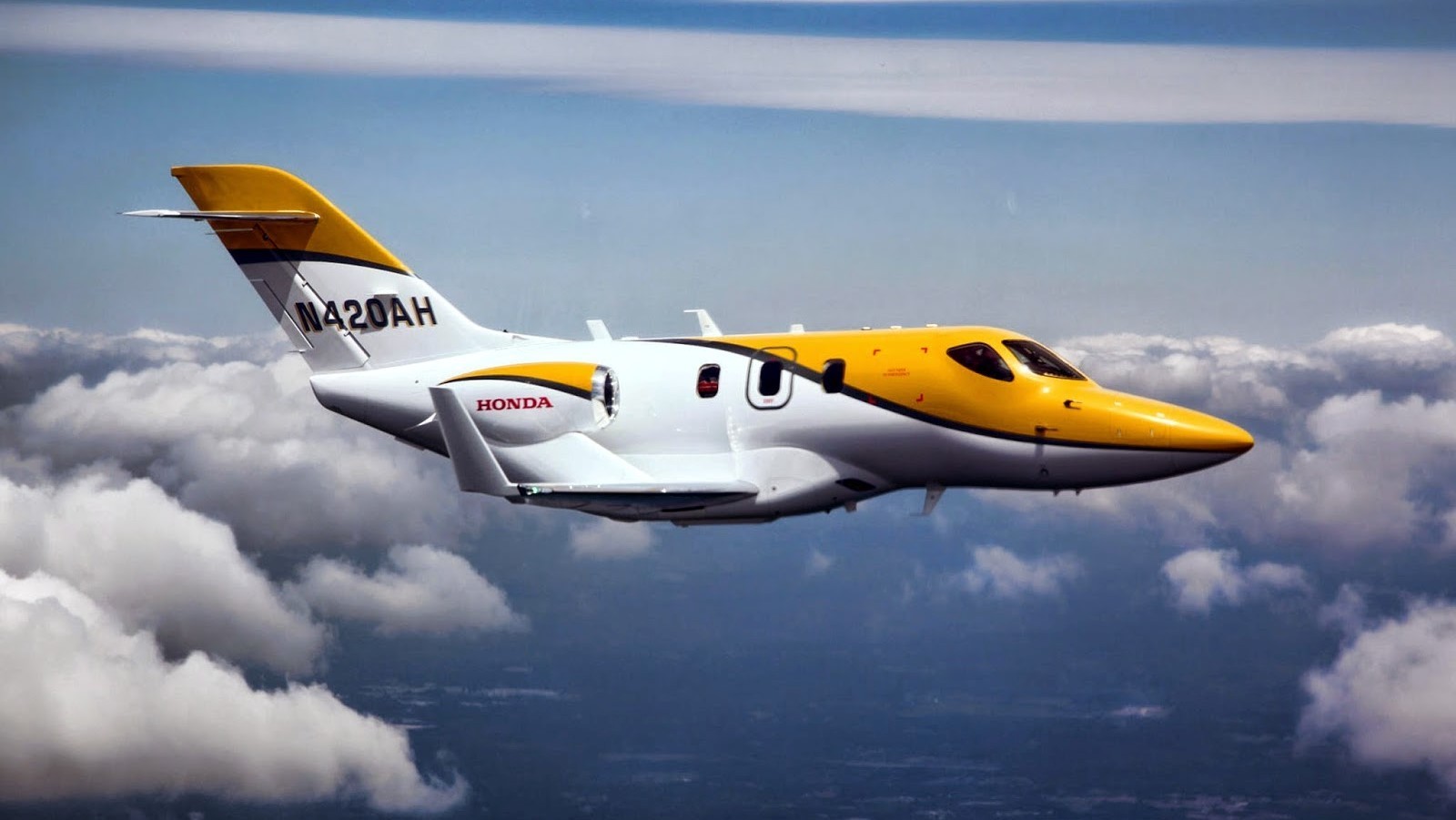
These are our own figures for this aircraft, not somebody else’s estimate. They are whole-aircraft prices for the sectors named, at the passenger count shown, and they move with the date, the positioning of the aircraft and the fuel price on the day. Treat them as the size of the number rather than as a quotation: only a written quotation against your dates is a price. Our own guide rate for the type is EUR 2,900 per flight hour; the sector figures below are whole-aircraft prices and are not that rate multiplied by the flight time.
| Sector | Passengers | Price | Time |
|---|---|---|---|
| Larnaca - Milan | 2 | 9000 € | 03:12 |
| Larnaca - Mykonos | 2 | 4000 € | 01:24 |
| Larnaca - Athens | 2 | 3000 € | 01:00 |
Tell us your route, your dates and how many of you there are. Your dedicated flight advisor will come back with availability and a firm price.
These are the types our partner operators' aircraft page groups alongside the HondaJet. Every figure quoted below is from their specification tables on this website.
Listed at 2,987 km, 6-7 passengers and a 4.14 m cabin. Nearly a thousand kilometres more range, a shorter cabin, two more seats.
See the Cessna Citation CJ2+/CJ2 ›Listed at 3,232 km, 6-7 passengers and 2.07 m³ of hold. The longer-legged light option on the same partner operators' aircraft page.
See the Cessna Citation Bravo ›Listed at 3,650 km, 6-8 passengers, 2.27 m³ of hold and a flight attendant. The light jet to step up to when the sector is over two hours.
See the Embraer Phenom 300 ›All partner operators' aircraft are on the aircraft index. Also useful: all published routes, current empty legs, jet sharing, how chartering works.