
An airliner-derived business jet with a 25.70 m cabin divided into five zones, up to twenty-six seats, eight to ten berths and 7,778 km of range - the longest published range of any aircraft on this website. It is the answer to a question most charters never ask, and the only answer when they do.
REQUEST A QUOTEEvery figure below is copied from the specification table on our partner operators' aircraft page for this type. The Lineage 1000E is a business jet built on an airliner airframe, and the cabin numbers are what give that away.
7,778 km of published range against a longest published route of 5,500 km. No sector on this website comes within two thousand kilometres of the limit. The interesting question on this aircraft is therefore not where it can go, but what twenty-six seats and a 25.70 m cabin are worth once it gets there.
Published range is a still-air figure at optimum cruise with a sensible payload. Load a cabin that seats up to twenty-six, put 12.54 m³ of luggage in the hold and fly a winter westbound sector against the jet stream, and the usable figure falls. On this aircraft, on this network, it does not fall far enough to matter: the longest route we publish is London to Dubai at 5,500 km, leaving 2,278 km of published margin, and the next longest is Amsterdam to Dubai at 5,169 km.
Where the range does earn its keep is in what it lets you carry. Range and payload trade against each other on every aeroplane: an aircraft flying near its limit gives up seats and luggage to buy fuel. An aircraft with 2,278 km in hand on its longest sector does not have to make that trade at all. On this type that means the full party, the full hold and the full catering on a seven-and-a-half-hour flight, without anybody being asked what they can leave behind.
It also means multi-leg itineraries stay on schedule. A Gulf sector followed by a European reposition and a second Gulf sector is three flights that a tighter aircraft would break up with a fuel stop. Here it is three flights.
The usual caveat stands, and it stands for every aeroplane on this site: published range is a specification, not a clearance. The operating crew plan against the real weight, the real weather and the real alternates on the day, and their figure is the one that governs. On the Lineage the gap between the two is large enough that you will never be told about it.
| Published route | Distance | Nonstop? | Margin against the published range |
|---|---|---|---|
| London to Dubai | 5,500 km | Yes, with margin | Inside by 2,278 km |
| Amsterdam to Dubai | 5,169 km | Yes, with margin | Inside by 2,609 km |
| Geneva to Dubai | 4,920 km | Yes, with margin | Inside by 2,858 km |
| Zurich to Dubai | 4,769 km | Yes, with margin | Inside by 3,009 km |
| Milan to Dubai | 4,662 km | Yes, with margin | Inside by 3,116 km |
| Dubai to Munich | 4,565 km | Yes, with margin | Inside by 3,213 km |
| Vienna to Dubai | 4,224 km | Yes, with margin | Inside by 3,554 km |
| London to Larnaca | 3,288 km | Yes, with margin | Inside by 4,490 km |
| Athens to Dubai | 3,273 km | Yes, with margin | Inside by 4,505 km |
| London to Paphos | 3,228 km | Yes, with margin | Inside by 4,550 km |
| London to Mykonos | 2,568 km | Yes, with margin | Inside by 5,210 km |
| Larnaca to Nice | 2,461 km | Yes, with margin | Inside by 5,317 km |
Below 2,400 km the question stops being interesting: every remaining route on this website is inside the range of this aircraft with room to spare. These are the mid-length ones, from about an hour and a quarter to two and a half hours by our own published flight-time estimates.
Distances are great-circle figures between airport coordinates from the OurAirports open dataset, retrieved 23 August 2026. Flight times quoted anywhere on this page are estimates from a model fitted to the flight times Diamond Executive Aero Services already publishes, not measured block times. The 19 routes shorter than 700 km are listed on the route index. Range figures are the ones published on our partner operators' aircraft page and assume still air, optimum cruise and a sensible payload.
25.70 m long, 2.68 m wide, 1.97 m high, divided into five zones. That is the entire argument for this aircraft, and no other type on this website comes close to it.
Five zones, not one cabin. Our partner operators' aircraft page describes an interior divided into five zones, each with its own purpose, laid out to a standard of passenger comfort rather than to a seat count. On board there is a galley, an entertainment system, a conference room and a lounge. A conference room on an aircraft is not a marketing phrase - it means a party of eight can hold a meeting while the rest of the passengers are somewhere else entirely, which on a seven-hour sector is the whole reason for chartering something this size.
Standing up. Cabin height is 1.97 m - just under two metres. Practically every adult passenger walks the full 25.70 m of that cabin without ducking. Only the two airliner conversions listed alongside it on our partner operators' aircraft page are taller, at 2.16 m and 2.25 m.
Width. 2.68 m across. For comparison, the large purpose-built business jets on this site run between 2.10 m and 2.41 m. Half a metre sounds trivial written down; in a cabin it is the difference between an aisle you turn sideways in and one you do not think about.
Sleeping. Eight to ten berths - more flat beds than any conventional business jet we list. On the Gulf sectors, and on the multi-leg trips this aircraft tends to be chartered for, that is what the specification is really selling.
Luggage. 12.54 m³. That is roughly double the 6.80 m³ of the largest conventional business jet on our partner operators' aircraft page and about four times what a typical super-midsize offers. Twenty-six passengers travelling for a fortnight is a volume problem before it is a seat problem, and this is the aircraft that solves it.
Crew. A flight attendant is carried. With a galley, a lounge and up to twenty-six passengers, that is a structural requirement of the cabin rather than an optional extra.
Cabin dimensions, berth counts, baggage volumes and the flight-attendant line are all taken from the specification tables published on this website, including the comparison figures quoted for other types.
The aircraft and the cabin as they are, and the seating plan underneath. These are the images we publish for this type.
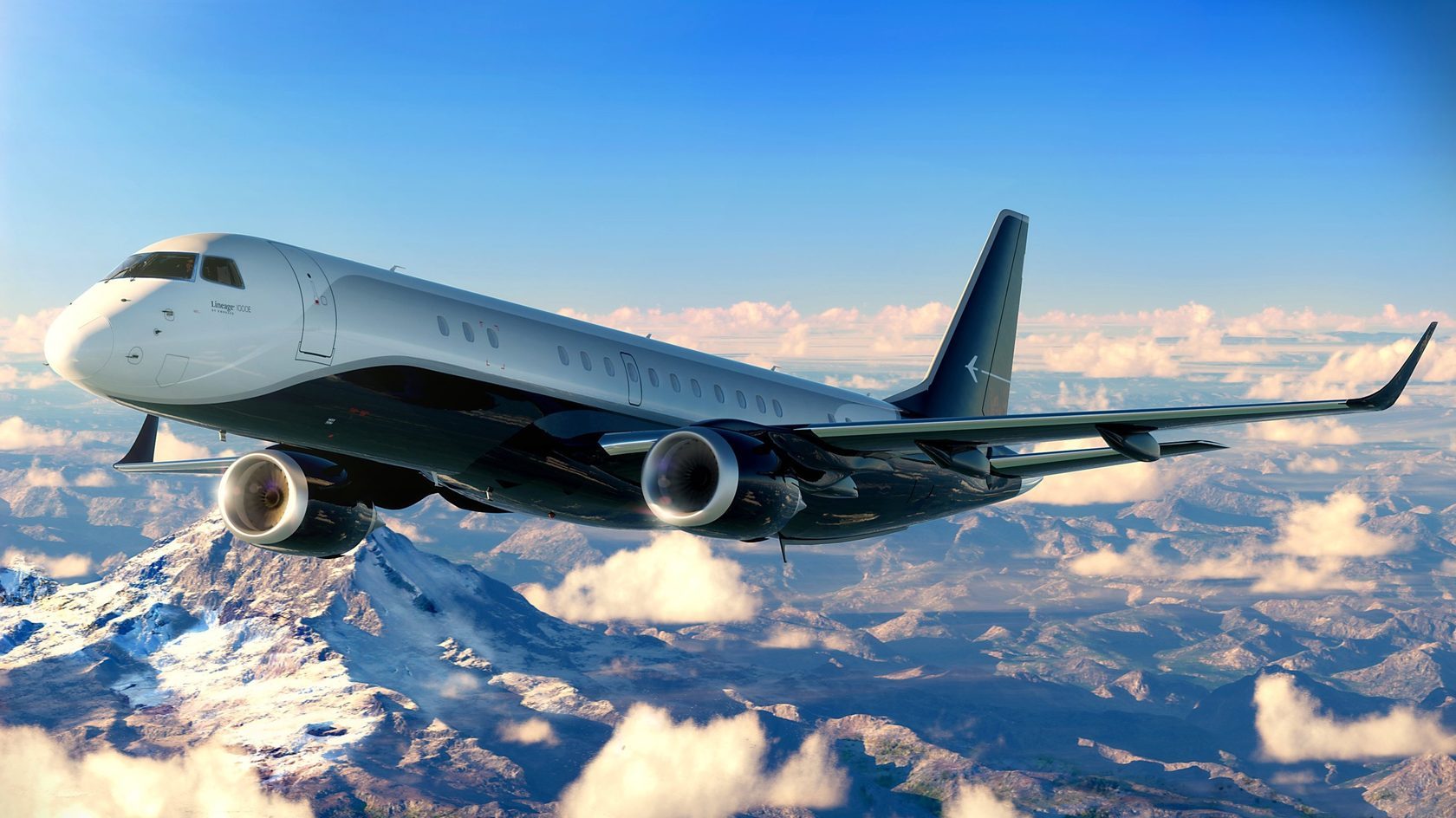
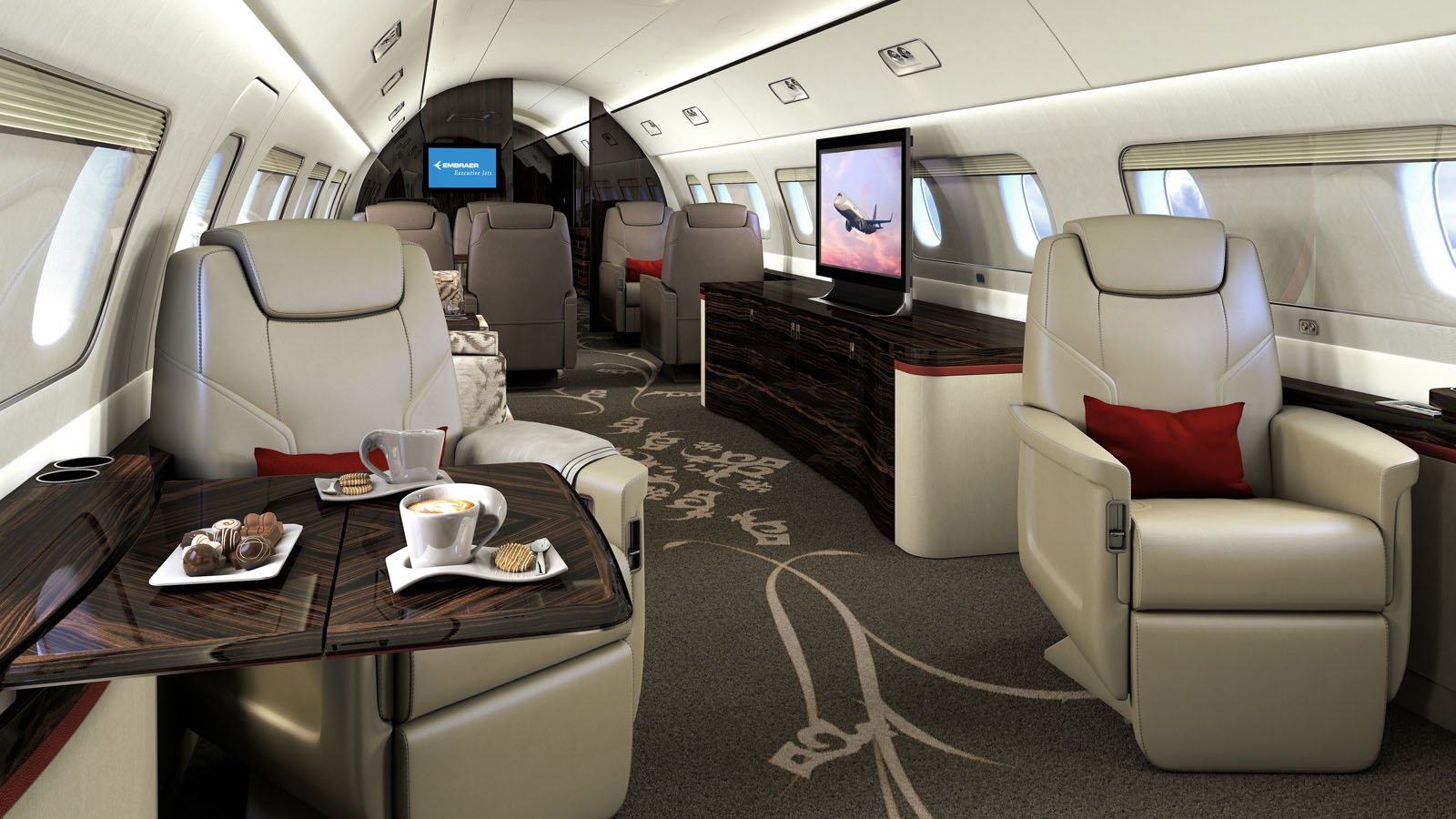
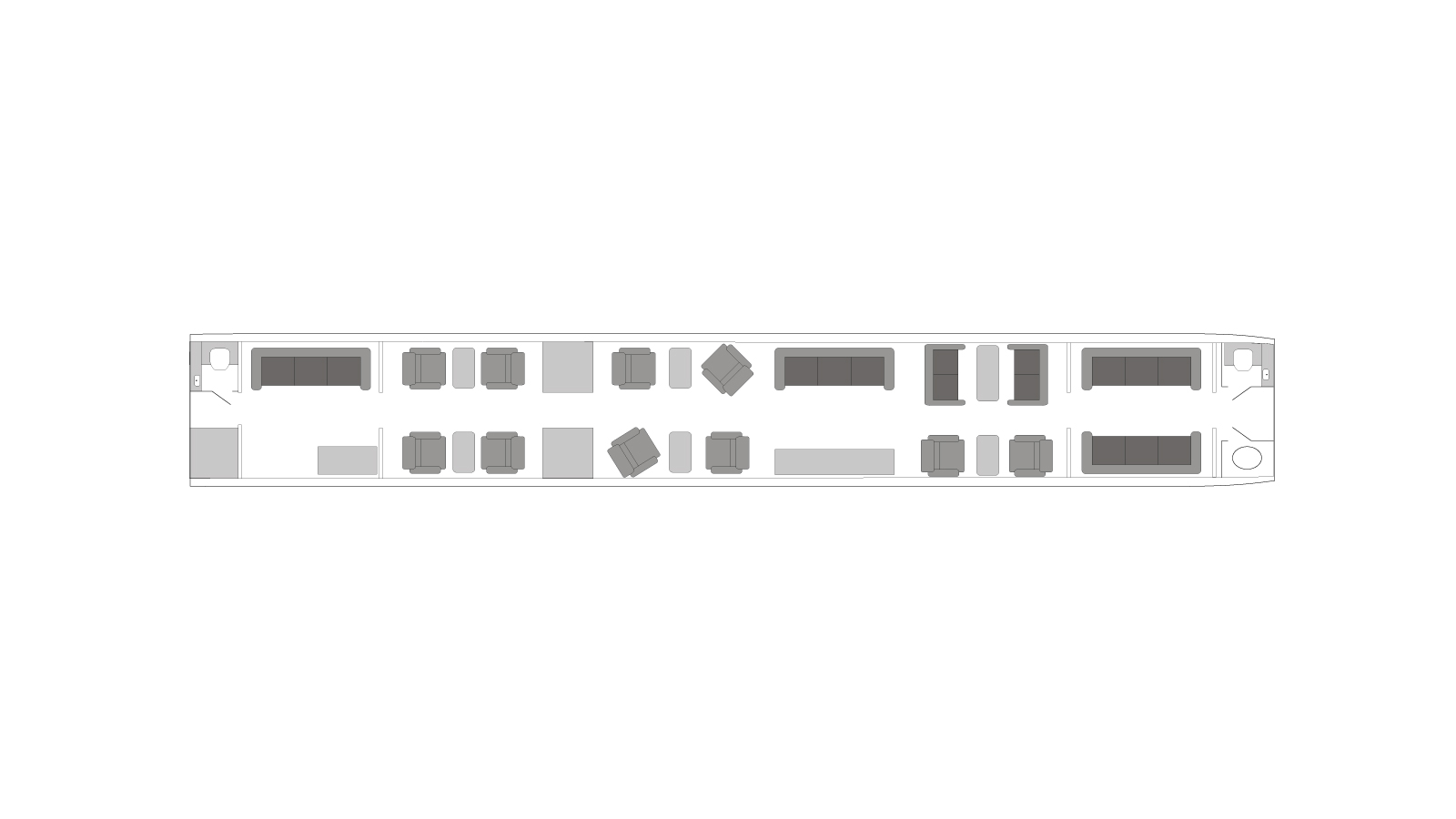
These are our own figures for this aircraft, not somebody else’s estimate. They are whole-aircraft prices for the sectors named, at the passenger count shown, and they move with the date, the positioning of the aircraft and the fuel price on the day. Treat them as the size of the number rather than as a quotation: only a written quotation against your dates is a price. We do not publish a rate-card figure for this type: aircraft of this size are quoted individually, and the sector figures below are whole-aircraft prices.
| Sector | Passengers | Price | Time |
|---|---|---|---|
| Larnaca - Geneva | 5 | 24500 € | 03:30 |
| Oman - Dubai | 10 | 22000 € | 01:00 |
| Larnaca - Zurich | 12 | 24500 € | 03:30 |
Tell us your route, your dates and how many of you there are. Your dedicated flight advisor will come back with availability and a firm price.
These are the types our partner operators' aircraft page groups alongside the Embraer Lineage 1000E. Every figure quoted below is from their specification tables on this website.
Listed at 11,100 km, 18-30 passengers, a 2.25 m cabin height and 27.70 m³ of hold. The next size up in every dimension.
See the Airbus Corporate Jet ›Listed at 10,269 km, 18-30 passengers and a 32.66 m cabin. Longer cabin, longer legs, same class of question.
See the Boeing Business Jet ›All partner operators' aircraft are on the aircraft index. Also useful: all published routes, current empty legs, jet sharing, how chartering works.